I think this drawing of us takes the cake. I especially like how Michael is holding his China Project and John has his Mac. And there's their car on School Hill!
Showing posts with label British values. Show all posts
Thursday, July 25, 2013
Goodbye Gifts
We've received the kindest goodbye gifts. We received a beautiful embroidered cushion of a London scene, several English-themed books (including one of the Royal Baby, born just a couple days ago!), window clings, pressed foliage (laminated especially for Anna), and Wirral mementos.
I think this drawing of us takes the cake. I especially like how Michael is holding his China Project and John has his Mac. And there's their car on School Hill!
Wednesday, July 24, 2013
Closing of the Butcher Shop
I couldn't believe it when I heard that Fred was closing his butcher shop. He and the other butchers have been a staple in our morning routine, waving as we walk by on the way to school, and often on the way home. Before we moved here, I would not have quite "got" the importance of a shop like Fred's. But it makes sense to me now. The butcher shop helps make the village a real community. He knows everyone; everyone knows him. The children at the school cheer when they hear that Fred's sausages will be featured at a school event. With a smile and a chat, he would give you whatever cut of meat you'd like. I once asked for chicken drumsticks and his colleague just cut the legs off a couple whole chickens and put them back in the window. They gave advice on meat preparation. His meat is locally sourced, and you'd literally see it arrive in a van in front of the shop.
Going to Fred's was like going to someone's house. It wasn't a store. It wasn't anonymous. You were a guest. It was comfortable, inviting, a nice place for a chat.
Michael: "He is very nice. I like waving to him in the morning and I like how nice he is."
Anna: "I like his sausages. I like waving to him in the morning."
Jennifer: "I loved that our Christmas turkey was hanging in the window."
Anna: "We got the best Christmas turkey. It was enormous."
Going to Fred's was like going to someone's house. It wasn't a store. It wasn't anonymous. You were a guest. It was comfortable, inviting, a nice place for a chat.
Michael: "He is very nice. I like waving to him in the morning and I like how nice he is."
Anna: "I like his sausages. I like waving to him in the morning."
Jennifer: "I loved that our Christmas turkey was hanging in the window."
Anna: "We got the best Christmas turkey. It was enormous."
Wednesday, July 10, 2013
Doors in England
| A little door leading to a house on Village Road |
I imagine there may be fire safety reasons for having so many doors in smaller spaces. Greater privacy may be another reason.
On the latter point, I've noticed that a lot of bedroom doors swing into the center of a room rather than toward a wall as they would in the US. In the US, there is a desire for openness in a room. In the UK, I think privacy may be more valued. With the door swung open in our bedroom here in Heswall, you cannot see our bed from the hallway. In the US, it is front and center as you walk up the stairs. I quite like the idea of moving our State College door hinges. Making the bed everyday can be a drag.
Tuesday, June 4, 2013
Paper Products in the UK: A Theory
![]() |
| Paper plate or taco: your call |
I'm sure a lot of this product product minimalism has to do with the cultural values of not being wasteful. However, I decided to buy a few disposable items here to use on those occasions that we just can't face washing the dishes again. (We don't have a dishwasher.)
Well, John was just eating a sandwich and his disposable plate buckled into a state of ruin as he ate. John said it was "the worst" paper plate he'd ever used.
This got me thinking. I used to think there was some additive that could be used in US products but not allowed here--kind of like that triangle you get on fine China which is only considered a health hazard in some US states and not others. However, I now wonder if paper products here are purposefully lower quality, a behind-the-scenes eco-government initiative. Think about it. Product dissatisfaction dissuades usage. Therefore, people waste less. I mean, I won't be buying those plates again. My plastic wrap gets tangled so I use a plate to cover my food. Paper shmaper. I will have to call my MP about this.
Wednesday, May 15, 2013
Why I Love British Garden Centres
| An ornament in the shop (photo by Anna) |
Anna, Grandma and I went to Gordale together yesterday. The three of us had such a nice time browsing in the store, and looking at the flowers and displays.
| A peacock! |
I like how someone at Gordale has thought about how to make the nursery itself visually interesting. It is not Dixieline. Among the flowers and plants are a lot of animal statues and ornaments to spot. Occasionally, signs ask people to smell certain flowers as if to say don't forget, this is a leisurely outing!
One benefit of living in a rainy country is that even a little gardening can yield a big payoff. So gardening is a big deal. On my parents' recent visit, my Dad marveled that no one irrigates regularly here. That was something that I struggled to comprehend too, as sprinklers and garden hoses and setting timers are just a fact of life in Southern California. Also, the terms "frontyard" and "backyard" are not part of the vernacular; instead, people have a "frontgarden" or "backgarden", which captures the smaller size and assumption that yes, there will be flowers. Flowers are also more noticeable in a smaller space, so why not plant them? As a parallel, I often buy indoor flowers here because you really see and can appreciate them when you walk into a room. In our open-plan American house, flowers can get a bit lost.
After our leisurely shop around (which included me trying on some quilted jackets), we went to the cafe for tea and cake. We left tired but happy, and with a box of grass seed for Grandpa.
![]() |
| Gardenias that say "Please smell" |
One benefit of living in a rainy country is that even a little gardening can yield a big payoff. So gardening is a big deal. On my parents' recent visit, my Dad marveled that no one irrigates regularly here. That was something that I struggled to comprehend too, as sprinklers and garden hoses and setting timers are just a fact of life in Southern California. Also, the terms "frontyard" and "backyard" are not part of the vernacular; instead, people have a "frontgarden" or "backgarden", which captures the smaller size and assumption that yes, there will be flowers. Flowers are also more noticeable in a smaller space, so why not plant them? As a parallel, I often buy indoor flowers here because you really see and can appreciate them when you walk into a room. In our open-plan American house, flowers can get a bit lost.
| A little San Diego on the Wirral |
Speaking of America, I like how Gordale has a warm indoor room with plants that look distinctively San Diegan-- bougainvillea, gardenias, hibiscus, cacti of every description... I imagine these survive as greenhouse or indoor plants here. John's mom said that when she first flew into San Diego to visit my parents, she thought she "landed in Gordale!"
| Little animal ornaments to entertain the kids |
Saturday, May 4, 2013
Anna's British Accent
Anna's American accent has been slowly replaced by British-sounding words and inflections. She was 5 when we arrived in Heswall, and she is now 95% of the way there, or "theh-ah", as she'd say. I especially like how she pronounces the word chocolate as "choh-co-lt" and tulip as "tyulip". She is also very "fond of" a lot of things, as she says, "Isn't it lovely?", pronouncing each "t" as a passing whisper.
Michael, who was nearly 8 when we arrived still sounds very American. I recall learning that age 8 is the cutoff for learning languages readily, that language is absorbed more easily in younger years. So theh-ah you have it.
Thursday, May 2, 2013
New Norms
Having lived here for eight months now, here are a few things I do seemingly automatically these days:
- Look to the right first when crossing a road;
- Go to the driver's side door when driving and the passenger's side when "passenging";
- Drive on the left, probably a good one to normalizet;
- Park with wheels up on the curb;
- Recognize and count coins without freaking out at the cash register;
- Bag my own groceries (and not place bags on the conveyor belt as I would at Wegmans);
- Eat with the fork in left hand with tines down and cut with the right;
- Leave without bussing my own table;
- Label dates with day/month/year;
- Apologize when someone else bumps into me;
- Apologize and thank at any opportunity available;
- Turn on the kettle;
- Ask guests if they'd like a cup of tea;
- Comment on the weather.
Tuesday, April 30, 2013
Swimming as a National Curriculum Requirement
I went with Michael's class to the swimming pool today. I thought it was quite an upheaval to have all Year 3 and 4 children take swim lessons for two weeks. It turns out that it is a requirement of the National Curriculum that all school children learn to swim by age 11. I found this information on the Department of Education website (http://www.education.gov.uk/):
"By the end of Key Stage 2 (age 11), pupils should be taught to swim unaided for a distance of at least 25 metres, using recognised strokes, on their front and back, and demonstrate an understanding of water safety). It is up to primary schools to decide when, and at what point they wish to teach this... Within the law, parents do not have a right to withdraw their children from this statutory element of the National Curriculum."I find the phrasing "do not have a right" very different from what I'd see in the US. The role of government is quite different-- greater trust that decisions are being made for the greater good.
At the pool, the swim instructors were all young, dedicated and looked like they walked out of an Abercrombie and Fitch ad. Uncanny. It was nice for me to see Michael's swimming take shape. He is in the middle group (blue team) of kids who can swim short distances without an aid.
On our way back, Michael and I sat together on the top deck of the bus. You can see so much from up high. The River Dee was sparkling and quite breathtaking, especially as the backdrop to the occasional farm or church (or even Church Farm, which we passed).
Thursday, April 18, 2013
"Dinner Ladies"
"Eating, like learning, must be conducted in an orderly atmosphere, and since the school is charged with training in table behaviour as part of its socialising role, the 'dinner ladies' are a part of the authority-structure of the school." (English Primary Education, p. 183)I've had lunch a handful of times at Easterly Parkway (Michael's US school). The scenes in the cafeteria are familiar to me-- groups of kids sit together at long tables, eating lunch either off trays or out of a lunch box or bag while chatting away with their friends. Given the number of kids in the room, suffice it to say, it's loud. Kids huddle or shout to hear each other. Unlike what I recall of my elementary school, the kids sit with their classes at lunch. The paraprofessional for their class wanders around to make sure everyone is settled. It seems a somewhat boisterous atmosphere with kids being kids. Anyone who finishes their lunch early can read a book or write or draw in a notebook. One day when I visited, a teacher brought in green swirled bread for all the kids in the class to try, creating a nice feeling of community, I thought. (It was delicious, by the way.)
At St. Peter's, the set up of the lunchroom is pretty similar-- long tables, kids with trays and lunch boxes. Like my elementary school, they sit where they'd like. Parents are not present at lunch, so I haven't had a chance to observe it first hand. My knowledge is based on the reports of Michael and Anna who say that lunch is quieter at St. Peter's. In fact, Michael one day told me, "My school in America is loud and my school in England is quiet." (My variation on this quote is, "In England, school children are quiet and teachers are loud; In America, teachers are quiet and school children are loud.") Both kids have been under the impression that talking is "not allowed" at lunch, but I imagine it is probably not encouraged as it might be in the US.
Maintaining lunch time decorum and finishing up one's lunch (another general requirement) is enforced by the school's "dinner ladies". I came across this description on a teacher's network website:
"Midday supervisors are the lynchpins of an army of support staff that patrols school playgrounds and cafeterias to ensure pupils are fed, appropriate behaviour promoted and order prevails. The change of name from ‘dinner lady’ to’ lunchtime or midday supervisor’ signifies a new recognition for this role: schools are keen to maintain consistent standards of pupil behaviour at break times." (TES Connect, http://www.tes.co.uk/)I like the descriptors of an army that patrols, with the focus not only on eating but also consistent standards of orderly behavior.
It dawned on me that the cafeteria is a microcosm of the culture at large. At Easterly Parkway, lunch time reinforces American values--openness, freedom of expression, independence, making your own decisions. Lunch time is viewed as a break in the day; the kids can be kids. At St. Peter's, lunch time is not break time as much as an extension of the school day and of learning. The children must continue being mannerly, orderly, rule abiding, trusting of authority. Break time is not about breaking free and being a "kid" like at Easterly, it is about keeping calm and carrying on. Lunch is formal rather than casual, orderly rather than "free".
Having heard Michael and Anna refer to dinner ladies' "shouting" and "telling off" pupils, I asked some mums about dinner ladies. This question usually brings about a slight shudder. Apparently, dinner ladies have induced fear in school children over the past several decades. A couple mums said that the dinner ladies at St. Peter's seem mild compared with their childhood experiences. It was widely enforced that you eat your food, you clean up after yourself, you remember your manners, you are orderly and not disruptive. At least at St. Peter's, you can earn a sticker from the dinner lady.
Dinner ladies inspect lunch boxes to check that children have made a decent attempt to finish their food. This, coupled with the school's policy about healthy lunches means that Anna doesn't want us to put chocolate or crisps in her lunch box. I doubt the dinner ladies would comment on an unhealthy item, but the desire to not find out is motivation enough. Even on her birthday, she said "no, thank you" to a little cupcake. I learned at the "Coffee & Chat with Mr. Penn" that schools on the Wirral have lunch box audits from time to time, and St. Peter's was #1in health last time.
Monday, March 18, 2013
Iconic Britain
I was just reading the newspaper and there was a short article on the Silver Cross Pram, the iconic British baby carriage that was first given to Queen Elizabeth decades ago. I've seen that pram appear in magazines typically with posh celebrities with lattes and pashminas pushing their slumbering babies through Central Park or perhaps Regent Street or Green Park. The Pram is classy and like the Rolls Royce, Aston Martin or Jaguar, is distinctively and stylishly British.
I started thinking about how Britain is just really good at iconic marketing. Quietly posh, elegant, regal iconic marketing. Yes, the monarchy, the Mall, images of Buckingham Palace, Big Ben (which Anna and Michael will tell you is actually Elizabeth Tower and Big Ben refers to the bells as we learned on our bus tour), Tower Bridge, Westminster Abbey, are sort of a given.
The color red is very dominant here. There is definitely a British red. It is not shouty but it is bright. The red phone boxes, the red letter boxes, the red postal vans, one can't help but want to photograph them and stick them on a wall. All are the same rich tone of red, very identifiable, stable and consistent--like British culture. Paired with the red on the Union Jack and English flags, you get a lovely coordinated set of colors.
When my friend Jen and I and our kids went to the London Transport Museum in October, I was impressed by the level of thought put into iconographic transportation. Most people can picture the black London taxi and the red double decker bus. Even the London Underground, which itself looks like a standard subway train, was strategically given an iconic, very visible round red logo with a solid blue stripe joining each end. The Underground and buses allowed people to move to the suburbs and commute into the city for work. It was advertised that in the suburb, there was more space for a family, more greenery and fresh air and that transportation was heroic in affording this new opportunity.
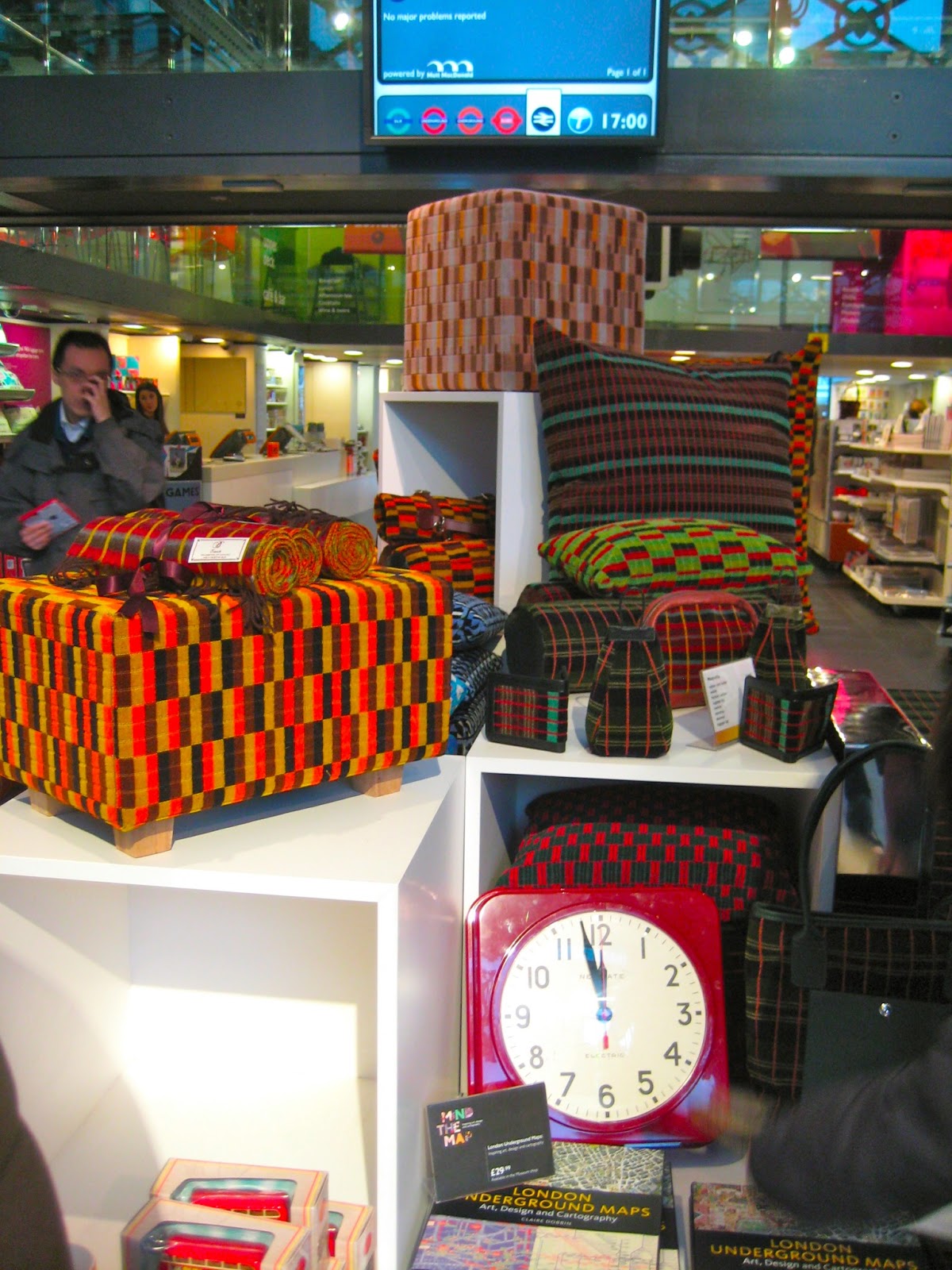
The Transport Museum also featured examples of subway station designs. Each station can be identified by its own distinct patterns and colors. Various train lines (e.g., Northern line, Jubilee line) also have specific seat upholstery designs associated with them. In the gift shop, my friend Jen pointed out the big display of upholstered furniture and luggage based on the Underground designs that one could buy for their own home. What a concept. Public transportation is typically thought of as a basic service, no frills, no personality, anonymous, and indeed "public". The fact that people desire and aspire to own and proudly identify with a piece of the Underground means they are doing something right.
I haven't even yet mentioned Andy Warhol, the Beatles, most pop music of the 80's... Britain even "owns" the concept of a teapot and fine china. And biscuits. At least Americans have donuts and Coke.
I started thinking about how Britain is just really good at iconic marketing. Quietly posh, elegant, regal iconic marketing. Yes, the monarchy, the Mall, images of Buckingham Palace, Big Ben (which Anna and Michael will tell you is actually Elizabeth Tower and Big Ben refers to the bells as we learned on our bus tour), Tower Bridge, Westminster Abbey, are sort of a given.
The color red is very dominant here. There is definitely a British red. It is not shouty but it is bright. The red phone boxes, the red letter boxes, the red postal vans, one can't help but want to photograph them and stick them on a wall. All are the same rich tone of red, very identifiable, stable and consistent--like British culture. Paired with the red on the Union Jack and English flags, you get a lovely coordinated set of colors.
When my friend Jen and I and our kids went to the London Transport Museum in October, I was impressed by the level of thought put into iconographic transportation. Most people can picture the black London taxi and the red double decker bus. Even the London Underground, which itself looks like a standard subway train, was strategically given an iconic, very visible round red logo with a solid blue stripe joining each end. The Underground and buses allowed people to move to the suburbs and commute into the city for work. It was advertised that in the suburb, there was more space for a family, more greenery and fresh air and that transportation was heroic in affording this new opportunity.
![]() |
| "Underground" inspired furniture |
I haven't even yet mentioned Andy Warhol, the Beatles, most pop music of the 80's... Britain even "owns" the concept of a teapot and fine china. And biscuits. At least Americans have donuts and Coke.
Tuesday, February 26, 2013
It's a Pub Life
John and I went out on Saturday afternoon to do some planning. With notebook in hand, we drove to Raby and enjoyed a lovely pub lunch at the Wheatsheaf, definitely one of my favorite places on the Wirral. The pub is along a country road in a beautiful old farmhouse building with a thatched roof and thick wooden beams, a place seeping with character.
We sat near the stone fire at a wooden table among other patrons. I picture them all in cable knit sweaters though I know the couple across from us were buff and wearing instructor gear from The Underground training centre. A little boy with his dad and grandpa at the next table swept his finger across his dad's beer foam and licked it with a smile. Three pub pooches were gently slumbering under their respective tables. Dogs in pubs tend to be old, gentle and sweet. I think even our kids would be pleased to have them at their feet.
John went to order our drinks, and the bartender asked how Michael was enjoying his half-term break. It turns out that the bartender was Mr. __, the manager at St. Peter's Primary. He works at the pub on Saturdays and has been doing so for decades. I chatted with him briefly later and yesterday at school pickup. A nice man, clearly respected and looked up to by the kids at school.
We clearly aren't in America but instead in Postman Pat's village. We will have to bring Michael and Anna to the Wheatsheaf one Saturday to say hello and have some chips.
http://www.wheatsheaf-cowshed.co.uk/
We sat near the stone fire at a wooden table among other patrons. I picture them all in cable knit sweaters though I know the couple across from us were buff and wearing instructor gear from The Underground training centre. A little boy with his dad and grandpa at the next table swept his finger across his dad's beer foam and licked it with a smile. Three pub pooches were gently slumbering under their respective tables. Dogs in pubs tend to be old, gentle and sweet. I think even our kids would be pleased to have them at their feet.
John went to order our drinks, and the bartender asked how Michael was enjoying his half-term break. It turns out that the bartender was Mr. __, the manager at St. Peter's Primary. He works at the pub on Saturdays and has been doing so for decades. I chatted with him briefly later and yesterday at school pickup. A nice man, clearly respected and looked up to by the kids at school.
We clearly aren't in America but instead in Postman Pat's village. We will have to bring Michael and Anna to the Wheatsheaf one Saturday to say hello and have some chips.
http://www.wheatsheaf-cowshed.co.uk/
Polly Put the Kettle On
Every time I walk through the door, I feel a compulsion to turn on the kettle. I'm sure it has something to do with the weather and it certainly helps that our kettle is about two steps away from the door. To lean over and turn on the kettle is a break in the day. Absolute bliss.
There is something so reassuring and calming about the sounds of the kettle. The initial seething kettle, the crescendo of sound to a warm and vibrant "berkling" of the water as the kettle jiggles and the steam shoots out the spout.
I am convinced that the civility of a cup of tea (or 5) everyday is good for the body and soul. It is reassuring, centering, calming, social. I like that we break for tea (or coffee) in art class and photography class. I also recall watching a major cricket match in which "tea time" was called, so the players left the field to regroup over a cup of tea.
I once saw a greeting card that read, "With a cup of tea in your hand, you can do anything." I wholeheartedly agree.
There is something so reassuring and calming about the sounds of the kettle. The initial seething kettle, the crescendo of sound to a warm and vibrant "berkling" of the water as the kettle jiggles and the steam shoots out the spout.
I am convinced that the civility of a cup of tea (or 5) everyday is good for the body and soul. It is reassuring, centering, calming, social. I like that we break for tea (or coffee) in art class and photography class. I also recall watching a major cricket match in which "tea time" was called, so the players left the field to regroup over a cup of tea.
I once saw a greeting card that read, "With a cup of tea in your hand, you can do anything." I wholeheartedly agree.
Monday, January 28, 2013
20 Cultural Values
Here are some cultural values that I think are different from the US. I would guess that some of these are more pronounced among the middle or upper class, older generations, and those from traditional British families-- but with a ribbon of commonality or understanding among the general population.
- Modesty over bragging
- Fitting in over being different
- Not calling too much attention to oneself or one's own accomplishments
- Avoiding embarrassment for oneself or others
- Respect for hierarchy
- Importance of manners
- Being sensible
- Not criticizing people directly (unless in a hierarchy)
- Simplicity over fussiness
- Less in more
- No wasting; buy small quantities
- Rooting for the underdog
- Being too forward; giving people space
- Not being nosy; personal questions or overt friendliness are not to be doled out to just anyone
- "Keep calm and carry on"
- The importance of the weather
- Humor but not quite the same as US humor
- Being self-deprecating
- "With a cup of tea in your hand, you can do anything"
- "Customer service is not a 'thing'"-- American forms of friendliness particularly in customer service encounters can be viewed as inauthentic and "genericized" to the public; the Lower Village has great customer service due to the natural friendliness of those who work there; Costa Coffee or M&S seem to be exceptions with regard to customer service.
Friday, December 14, 2012
The Hidden Value of the Village Shop: Why Math(s) is Easier to Learn in England
| After school at the Village Shop (photo by Michael) |
We don't have shops like this in America that I can think of. The sweets at the Village Shop are simply priced (rather than weighed or taxed) and they are laid out at child level for their own choosing and counting. There are lots of sweets too and very easy to grab. There are no tongs; you use your fingers. No one gets up in arms about that (or maybe they just don't shop there). I have never seen a child get rambunctious or just take fist fulls of candy there. Perhaps it does happen but the mannerly-ness of the society probably wards against it.
On a side note, I've noticed that while American stores and restaurants are very big on "sneeze guards" and separate tongs for separate items, that really isn't the case here. The health and safety laws are probably different. When John and I went to a big cineplex, they had a self-serve pick-a-mix candy and snacks area. Though there were 30 things you could choose from, there were only a few tongs/scoops for all of them. If you have allergies, I guess you just learn to never eat any of those snacks. That would be the sensible thing to do.
The Importance of Manners
I'm at Michael and Anna's school a couple times a week, and have noticed that teachers often stop children due to manners. "Where are your manners?" or "Please mind your manners!" or "You are being rude!" or my personal favorite, "MANNERS!" I've heard that word more in the past 3 1/2 months than I recall hearing in my collective schooling from 5-21 years.
People in general widely recognize the concept of the English Gentleman--I always think of the display at the museum in Pittsburgh of "The English Gentleman" during the French and Indian War, for some reason, and my Dad has a joke about how you want a French chef, Italian lover and British police officer. And we watch Downton Abbey and Brideshead Revisited as distinctively British shows not only due to the accents but the politeness, restraint and mannerly-ness of the people.
The pupils at St. Peters are called out on manners a lot in cases that I think would flit by more easily in an American public school, at least based on my own experiences. Aside from the consistency of pleases and thank yous, I've seen children called out ("Manners!") for not quickly saying "excuse me" or "sorry" when accidentally bumping someone, for squeezing through a door past someone else, for "snatching" (rather than politely taking) paper from the teacher, speaking without being called on, cutting off someone mid-sentence, trying to dominate the discussion, taking more than one's share, being too loud...
When I helped out at Christmas Gift Afternoon, I was all smiles as children said lots of "Yes, please" and "No, thank you" and "Sorry" and "Excuse me". Most children were very considerate of the people around them, keeping the gifts in order. There were two brothers who accidentally walked off with some socks. A few minutes later, the boys came back: "May we buy this? I'm so sorry but I believe we walked off without paying." I think most American kids would do the same thing but perhaps state more to the point "Sorry, I forgot to pay. Here you go." British children/people leave a bit more room for their own error.
During Michael's class Christingle play, I liked seeing the representation of American Christians. While they correctly pointed out the diversity of America, the kids were dressed in the standard jeans, baseball caps, cowboy hats, sweatshirts, flag colors. They looked like Americans--casual, less about the formality of manners.
Funny, I happened to catch actress British Emma Watson (who played Hermione in Harry Potter) on the Ellen Show the other day talk about the difference between dating boys from America and England.
I laughed out loud not just at the general, "oh I get it" but the fact that I can see that plain-as-day developmentally and culturally when I go into the school here compared with what I know of American schools and homes.
People in general widely recognize the concept of the English Gentleman--I always think of the display at the museum in Pittsburgh of "The English Gentleman" during the French and Indian War, for some reason, and my Dad has a joke about how you want a French chef, Italian lover and British police officer. And we watch Downton Abbey and Brideshead Revisited as distinctively British shows not only due to the accents but the politeness, restraint and mannerly-ness of the people.
The pupils at St. Peters are called out on manners a lot in cases that I think would flit by more easily in an American public school, at least based on my own experiences. Aside from the consistency of pleases and thank yous, I've seen children called out ("Manners!") for not quickly saying "excuse me" or "sorry" when accidentally bumping someone, for squeezing through a door past someone else, for "snatching" (rather than politely taking) paper from the teacher, speaking without being called on, cutting off someone mid-sentence, trying to dominate the discussion, taking more than one's share, being too loud...
When I helped out at Christmas Gift Afternoon, I was all smiles as children said lots of "Yes, please" and "No, thank you" and "Sorry" and "Excuse me". Most children were very considerate of the people around them, keeping the gifts in order. There were two brothers who accidentally walked off with some socks. A few minutes later, the boys came back: "May we buy this? I'm so sorry but I believe we walked off without paying." I think most American kids would do the same thing but perhaps state more to the point "Sorry, I forgot to pay. Here you go." British children/people leave a bit more room for their own error.
During Michael's class Christingle play, I liked seeing the representation of American Christians. While they correctly pointed out the diversity of America, the kids were dressed in the standard jeans, baseball caps, cowboy hats, sweatshirts, flag colors. They looked like Americans--casual, less about the formality of manners.
Funny, I happened to catch actress British Emma Watson (who played Hermione in Harry Potter) on the Ellen Show the other day talk about the difference between dating boys from America and England.
"English guys are very well put together... They dress really well and they are very well mannered. But they are also very restrained.... [American guys] are very like open and very straight-forward—but they wear flip-flops and I don't know if I like that."
I laughed out loud not just at the general, "oh I get it" but the fact that I can see that plain-as-day developmentally and culturally when I go into the school here compared with what I know of American schools and homes.
Monday, November 12, 2012
I Don't Know How She Does It
I was greatly entertained by the fact that Anna and her friend marched out of school last week, each wearing one of these stickers on their uniforms. Anna was proud to have volunteered and I thought it was rather sweet, and also somewhat hilarious as an idea.
John and I were talking about how this approach probably wouldn't work in American schools. Allergies and food safety are a big concern, and I think there would be a few complaints about the marketing tactics. But this approach works here, and I am excited to help Anna with her baking tomorrow after she returns from Tesco with the ingredients.
Tuesday, November 6, 2012
Wasteless Culture: Where are the napkins, and will you please finish up your lunch?
As much as I love America, it is admittedly a wasteful culture, particularly when contrasted with UK living. Relatively speaking, the UK is a wasteless culture. Some examples of consumer products based on my narrow window of observation:
- Napkins are typically specialty items and cannot be purchased in large bundles at Tesco; napkins and condiments are usually handed to you at restaurants upon asking rather than serve yourself.
- Paper towels (a.k.a. kitchen roll) are much smaller.
- Paper plates and cups are not readily available and not typically used unless at a barbecue; we've also had our fair share of hot dogs and burgers (and crepes in Paris!) handed to us on a napkin without a plate.
- Fewer options in cling film, foil, tupperware-type storage.
- No plastic bags (or few) to put meat in at the grocery store. (The packaging is more secure.)
- You bag your own groceries so you are made aware of how many plastic bags you use; most people seem to have reusable bags.
- Pre-packaged produce is modestly sized.
- Cookies (a.k.a. biscuits) are often packaged in strips (one row) rather than boxes (multiple rows) or bags.
- Juice is commonly sold in the thin carton rather than the wider one.
- Eggs are most commonly sold in 6's instead of 12's.
- Due to smaller storage space, we tend to just buy what we need.
- We have one garbage bin and it is collected every 2 weeks, so you must be conservative in throwing things away.
- Recycling is really easy; we have one garbage can for all recycling.
- Smaller food portion size in restaurants, and no doggie bags to take food home (that is literally a foreign concept).
- Cultural value of "finishing up" one's meal.
| Look at this standard bag of chocolate chips--smaller than a tea box! |
Right or wrong, I've started packing smaller lunches for Anna as a way of coping. In fact, one day, Anna was spotted by a teacher for finishing her lunch and as a result, earned a "Lunchtime Superstar" sticker. The child was delighted.
| WWI sign posted on Facebook |
The UK also has its version of plenty in consumer products. Whereas Wegmans in PA has loads more paper products and bigger product sizes, in my observation, Tesco has more shelf space devoted to certain products for which there is greater consumption:
- Prepackaged yogurt types and varieties
- Refrigerated foods (these are amazing)
- Beer and wine (which isn't even sold in PA grocery stores)
- Biscuit and cake varieties
Saturday, October 20, 2012
Being Sensible
A big part of English culture is the concept of being sensible. The kids and I were invited over for an after-school playdate, and the I liked how the mom/mum reminded her kids to "be sensible" while playing. I've heard this phrase repeated at school, in the village, on TV... It's a phrase that we don't use much in the States.
Being sensible is an internalized idea. It is about having sound judgment, using reason, and simply making the "right", principled decision. The right decision is principled, so taking into account not just yourself but the greater good. You must be perceptive and intuitive.
I think that an American parent would tend to say, "Are you making the right decision?" That phrasing feels different to me, perhaps because it seems more proactive and conscious reasoning/thinking, a certain level of being rational and logical. It also somehow gives the child a sense of control and self-importance.
I see this subtle difference play out in the media. I recently heard a sad news report on BBC Radio 4 of a mother who murdered her two young children. Because she was diagnosed with post-partum depression, she was charged with "diminished responsibility" and the murder charges were dropped. Around the same time, there was an article on CNN about a similar situation in the US with murder charges pending. The handling of these two cases is very British/sensible in the first case and American/rational in the second. If you step back and look at the evidence, it is sensible to drop the charges. However, if you are hard and fast rule abiding, the logical decision is jail time.
In September, I was also struck by an interview on BBC of a cyclist who witnessed a shooting in France. The shooting had only happened a day earlier, and the witness was allowed to tell his full story to the media. The witness talked openly about how he reacted at the scene, what he did and should have done, etc. He obviously had no fear of implicating himself, being sued for saying too much or misleading the audience. The interviewer was very encouraging of how the cyclist handled the situation; there was a lot of trust that he did what he felt was right at the time and he empathized with him. The interviewer also did not use words like "alleged".
I find it very interesting that people are viewed as almost more "human" here. Hard lined rules are no match for sensibility.
Tuesday, September 11, 2012
Customer Service at the Crepe Counter
The first time we went shopping, John's cousin Sal and I had a conversation about customer service in the UK and US. In the US, the customer is always right and people who work in stores and restaurants tend to be really polished and friendly, like they are your best friends. That level of buddy-buddy-ness can be quite misleading if you are not american. In the UK, the customer is usually really polite and the people who are working are not typically bubbly or pandering but rather authentic. Why act like best friends with someone you don't know?
In fact, I see this play out a lot in social interactions here-- in Harrogate with the mums group, with our neighbors here, people usually leave you alone and may not say hello until you actually know each other. It's not rudeness, it's just not being fake.
Back to shopping.. while at the mall in Wales, we decided to stop for coffee and food. I spotted an outdoor creperie (big sign says "CREPERIE") so we went over to order. There was a teenager working the front and a couple other ladies making coffee. The menu was simple: (1) hotdogs and kids' food, (2) jacket potatoes list, (3) panini list, (4) crepes list. I was careful to be polite with my phrasing so as to not be viewed as an efficient demanding american.
CG looks back at me with complete apathy, slight frown, not in empathy but disdain for my existence.
In fact, I see this play out a lot in social interactions here-- in Harrogate with the mums group, with our neighbors here, people usually leave you alone and may not say hello until you actually know each other. It's not rudeness, it's just not being fake.
Back to shopping.. while at the mall in Wales, we decided to stop for coffee and food. I spotted an outdoor creperie (big sign says "CREPERIE") so we went over to order. There was a teenager working the front and a couple other ladies making coffee. The menu was simple: (1) hotdogs and kids' food, (2) jacket potatoes list, (3) panini list, (4) crepes list. I was careful to be polite with my phrasing so as to not be viewed as an efficient demanding american.
- Me to Crepes Girl (CG): "Hello, may I have a cheese and tomato crepe, please?"
CG looks back at me with complete apathy, slight frown, not in empathy but disdain for my existence.
- CG: "It will be a wait." (I can even still hear her accent)
- Me: "Okay...
- Me: "May I instead have a panini, how about ham and cheese?"
- CG: "We are out of paninis."
- Me: "Oh, okay. "
- Me: "May I have a jacket potato with cheese then?"
- CG: "We are out of jacket potatoes."
- Me: "So what do you have?"
- CG: "Hot dogs."
Our Village
There are various aspects of our village that make me feel like we live in an old fashioned place. It looks old fashioned. Many of the buildings pre-date World War I and II, and the roads were carved in long after the town was formed. Here are a few things I have noticed.
Formalities. This is funny, but I quite like being called Mrs. Coupland. This happens more than you would imagine. In the US, first names are pretty common, but it seems like most people who phone and various people I meet (e.g., Rainbows leader, assistants at St. Peter's, teachers, bank tellers) call me Mrs. Coupland. I am in turn then saying hello to Mrs. X and Y in the front office, Mr. Penn the headmaster and so on. I like the formality of it. I feel like I stand a little straighter and am somehow more polite. I am also offered cups of tea wherever I go-- visiting the school, stepping into a neighbor's house, drawing class, photography class... There are also formalities of talking about the weather-- while it was pouring rain today, I past a man in the lower village, holding his paper saying "Lovely weather, isn't it?"
Everyday Life in the Village. Walking down Village Road, there is a lot to see. It's like a storybook. In the mornings, on the way to St. Peter's Primary, we always see people go into the Village Shop to buy their newspapers, and the butchers are out putting produce into baskets. Later in the day, I wave to the hairdresser and the butchers, buy the newspaper at the Village Shop, occasionally see Sally's mum working in the convenience store while buying milk and eggs, mail letters in the bright red post box. After school, the kids always stop at the wall by the red phone booth to sit or jump down. They like running across the road to "the sweeties shop" where they can literally pick out penny sweets in a basket. Apparently, we have been seen a lot in the village, because various people I meet will say, "oh yes, I've seen you walk through the lower village." It feels very quaint and busy in the village. If you ever feel lonely or tired, it's nice to just stop out onto Village Road and experience life happening.
Words. The word "shop" rather than "store" and "village" rather than town seem very old fashioned and rather quaint to me. I find myself also saying "thank you" 4x more than I would in the US. Some interesting word comparisons (old-fashioned vs. modern):
Shop - Store
Sweets - Candy
Village - Town
Mr. or Mrs. - First name
Secretary - Administrative Assistant
Holiday - Vacation
Pardon? - What?
Oh dear - Uh oh
AllLookTheSame.com. John and I were once very entertained by a website of that name which basically proves that Asian people "all look the same". Similarly, a lot of the people in our town "all look the same". To be fair, we are in a fairly middle-upper class village, not a big city like London, and our children attend a Church of England school. Most people we see daily are caucasian, light skinned, many with lighter hair (which causes all sorts of confusion for me). By contrast, I look different. When I speak, I sound different. Include the kids, and we are a stand-out trio. This has really helped me in meeting people and being remembered. I actually quite like that. It also poses interested challenges for my memory. The first few days of school, several very nice mums at drop off would ask, "How is Anna settling in?" and I'd think, do I know you? I really have to concentrate to remember.
Size. I am certain that things in the US have gotten bigger and bigger over the past few decades--houses, cars, food portions, refrigerators, appliances, toys, quantities of toys, expectations, people. Here, the footprint of the average person is probably relatively small by comparison. Smaller spaces and cars, definitely. Buying food in the store, produce for one tends to come in much smaller packaging. I often wonder if I should buy two packages of asparagus, but most people just buy one. Skinny containers of juice are very popular because they fit in the fridge well as opposed to the huge ones. Having excess is not a value. People don't really strive for leftovers; in fact, most restaurants don't offer a doggie bag, like is very typical in the States. Here, you just eat what is in front of you, and it is appropriately portioned. Because houses are generally smaller (there are, of course, some exceptions here in Heswall), people own less and show that we really need less. The exceptions to size are the beer pint, crisps and biscuits.
Formalities. This is funny, but I quite like being called Mrs. Coupland. This happens more than you would imagine. In the US, first names are pretty common, but it seems like most people who phone and various people I meet (e.g., Rainbows leader, assistants at St. Peter's, teachers, bank tellers) call me Mrs. Coupland. I am in turn then saying hello to Mrs. X and Y in the front office, Mr. Penn the headmaster and so on. I like the formality of it. I feel like I stand a little straighter and am somehow more polite. I am also offered cups of tea wherever I go-- visiting the school, stepping into a neighbor's house, drawing class, photography class... There are also formalities of talking about the weather-- while it was pouring rain today, I past a man in the lower village, holding his paper saying "Lovely weather, isn't it?"
Words. The word "shop" rather than "store" and "village" rather than town seem very old fashioned and rather quaint to me. I find myself also saying "thank you" 4x more than I would in the US. Some interesting word comparisons (old-fashioned vs. modern):
Shop - Store
Sweets - Candy
Village - Town
Mr. or Mrs. - First name
Secretary - Administrative Assistant
Holiday - Vacation
Pardon? - What?
Oh dear - Uh oh
AllLookTheSame.com. John and I were once very entertained by a website of that name which basically proves that Asian people "all look the same". Similarly, a lot of the people in our town "all look the same". To be fair, we are in a fairly middle-upper class village, not a big city like London, and our children attend a Church of England school. Most people we see daily are caucasian, light skinned, many with lighter hair (which causes all sorts of confusion for me). By contrast, I look different. When I speak, I sound different. Include the kids, and we are a stand-out trio. This has really helped me in meeting people and being remembered. I actually quite like that. It also poses interested challenges for my memory. The first few days of school, several very nice mums at drop off would ask, "How is Anna settling in?" and I'd think, do I know you? I really have to concentrate to remember.
Size. I am certain that things in the US have gotten bigger and bigger over the past few decades--houses, cars, food portions, refrigerators, appliances, toys, quantities of toys, expectations, people. Here, the footprint of the average person is probably relatively small by comparison. Smaller spaces and cars, definitely. Buying food in the store, produce for one tends to come in much smaller packaging. I often wonder if I should buy two packages of asparagus, but most people just buy one. Skinny containers of juice are very popular because they fit in the fridge well as opposed to the huge ones. Having excess is not a value. People don't really strive for leftovers; in fact, most restaurants don't offer a doggie bag, like is very typical in the States. Here, you just eat what is in front of you, and it is appropriately portioned. Because houses are generally smaller (there are, of course, some exceptions here in Heswall), people own less and show that we really need less. The exceptions to size are the beer pint, crisps and biscuits.
Subscribe to:
Posts (Atom)